EchoSense (Echo 1)
A neck-worn AI navigation wearable for the visually impaired — real-time obstacle and drop-off detection running fully offline on an edge accelerator.
Overview
EchoSense (Echo 1) is a neck-worn navigation wearable that helps visually impaired users move safely through the world. It runs entirely offline on a Raspberry Pi 5 paired with a Hailo-10H accelerator (40 TOPS), fusing a 200° camera, GPS, and a ground-facing LiDAR to detect obstacles, steps, and drop-offs — then speaks clock-direction alerts.
It was my graduation project (team of 6), graded A+ and featured on television. I owned the safety and navigation engines, the on-device model pipeline, and the public launch site.
What I built
Edge-optimized vision
Compiled and quantized YOLOv8n to Hailo INT8 (FP32→INT8, ~4× smaller) for ~30 FPS real-time detection fully on-device.
Offline scene understanding
Ran an offline SmolVLM2 vision-language model for scene description and faster-whisper push-to-talk speech — no cloud, full privacy.
Safety engine
Engineered camera + LiDAR hazard fusion into clock-direction alerts, plus a GPS navigation engine, as process-isolated services over a ZeroMQ event bus.
Product launch site
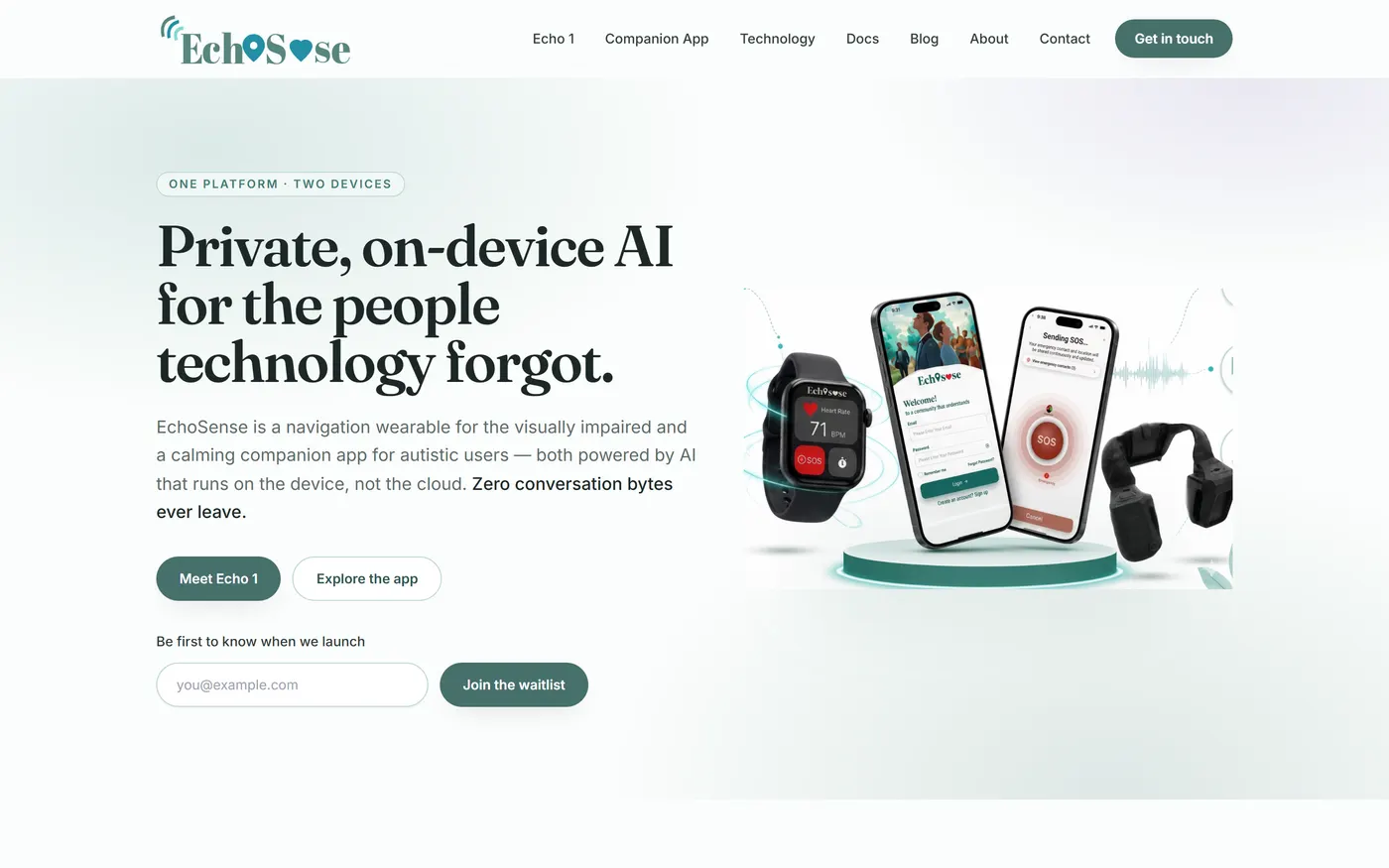
Designed and deployed the public launch site at echosense.org with an Apple-style product aesthetic.
Built with
- Raspberry Pi 5
- Hailo-10H
- YOLOv8n
- SmolVLM2
- ZeroMQ
- LiDAR
- Python
Have a project in mind?
Whether it’s a business website, an app, or something AI-powered — tell me about it and I’ll reply the same day.